KEVIN ZHU · STRATEGY & OPERATIONS
OpenAI · SEA & ANZ · Application
Strategy & Operations Lead — SEA & ANZ · Application Portfolio

Operating
systems,
built to scale.

从真实经营出发——先把系统搭出来,再把它规模化。
Fourteen years across foreign trade, ToB SaaS and cross-border marketing; now a business-unit P&L owner running an AI-native organization.

Kevin Zhu 朱盼恒 · Senior Operations Director, DTC Business Unit · Zhongqi Group (300.cn)
[email protected] · LinkedIn · me.superk.ai
¥240M
Revenue built from zero in the unit's first three quarters
200+
Cross-functional team orchestrated: product, sales, delivery, CS
45→90%
Client renewal rate after commercialization & delivery redesign
50%+
Delivery efficiency gain from the AI agent production line I designed
HOW I RUN

Take the mandate. Build the system. Scale it.

Every chapter of my career is the same motion at a bigger scale — the motion this role asks for: translate a high-level goal into an operating system that survives without heroics.

01
Mandate
Ambiguous, fast-scaling goal from the top — no playbook attached.
02
Operating model
Positioning, org design, price ladders, service boundaries.
03
Execution system
Delivery SOPs, KPI & reporting frameworks, operating cadences.
04
AI leverage
Agent labor where work is repeatable; people where judgment is scarce.
05
Scale & renew
New markets and channels on the same rails; renewal loops close the system.
What I've run
  • A DTC business unit, 0→1 — P&L owner, reports to Group CEO
  • A 200+ person cross-functional organization: product, sales, delivery, customer success
  • An ads business across 5 channels and 3 continents: Google, Yandex, Meta, TikTok, Bing
  • Products that had to be sold, delivered and renewed — not just shipped
What I believe about operations
  • Strategy is a rumor until it has an org, a cadence and a dashboard.
  • Scalability is a service-design problem: boundaries, SOPs, price ladders.
  • AI gives operations 10x leverage — if you redesign the division of labor first.
  • Renewal rate is the most honest KPI in any services business.
CASE BOOK

Seven systems, one method.

Each case below is a system that had to survive contact with real customers, real revenue and real renewal cycles.

CASE 01 · BUSINESS UNIT 0→1
2023 — PRESENT

DTC Business Unit: a region built inside a company

Given a blank page by the Group CEO — stand up a cross-border DTC business for the group — I ran it exactly the way a market entry is run: insight first, then operating model, then execution rails.

¥240M
Revenue in the unit's first three quarters
1,000+
Paying customers within 6 months of launch
45→90%
Renewal rate — the system's proof, not a sales push
The mandate & what I built
  • Market insight → product positioning → org modeling → P&L decomposition, end to end
  • Commodity design with price ladders and explicit service boundaries
  • Delivery SOPs and an operating cadence connecting sales, delivery and CS
  • Renewal loop: usage reviews, risk flags, save plays — renewal 45% → 90%
How it's governed
  • One P&L, decomposed to pod level; margin tracked by product line
  • Weekly ops cadence: pipeline, delivery risk, renewal forecast
  • AI leverage inside the unit: agent production line for site delivery (Case 04)
  • Team structure rebuilt as pods — flat, AI-native, accountable to numbers
Operating principleA new market fails on quiet gaps — nobody owns the renewal call, nobody sees delivery risk until it's late. So the first system I build is always the accountability map: who owns which number, reviewed on which cadence, with which escalation.
CASE 02 · MARKET ENTRY
2023 — PRESENT

Omnichannel ads: five channels, one operating system

Led the group's advertising business as the Google (China) reseller agency team leader — then expanded it into four more channels, each with its own commercialization model and delivery org. Expansion as repeatable method, not adventure.

5
Channels operated: Google, Yandex, Meta, TikTok, Bing
2
Yandex awards: China B2B Agency Growth · Global Quality Partner
0→1
Commercialization + delivery org built per new channel
The expansion pattern
  • Size the market before the MoU: demand, price bands, service gaps
  • Package the offer for that channel's economics — never copy-paste Google pricing
  • Stand up delivery capability and SLA before the first invoice
  • Prove on lighthouse clients, then industrialize the playbook
Why this maps to regional expansion
  • New channel ≈ new market: local dynamics, regulation, pricing logic
  • Operational readiness before growth — my launches ship with SOPs attached
  • Multi-market fluency: the channels SEA & ANZ advertisers actually live on
  • Recognition earned on execution: Yandex growth + quality awards, China region
Operating principleEnter a market with the operating system, not just the contract. The deal is the easy 5%; commercialization design and delivery readiness are the 95% that decide whether year two exists.
CASE 03 · DELIVERY SYSTEM
2023 — 2024

Marketing Cloud: fulfillment rebuilt to 85%

Inherited an AI content-marketing product with a broken promise: contracts sold, fulfillment lagging. Rebuilt the delivery system — and made AI content quality an operating discipline instead of a gamble.

85%
Fulfillment / delivery compliance rate, within ~2 months
27 / ¥1.06M
Clients signed and revenue in launch month (avg. deal ¥39k)
3-on-1
Service model: strategist + AI content ops + account owner
What was broken → the rebuild
  • AI-generated SEO & social content shipped without a quality bar → keyword co-creation with clients: quality starts at the input
  • Every account bespoke → human confirmation gate on every AI content batch before it ships
  • Compliance failing faster than sales could sell → standard SOP + 3-on-1 service model, priced and packaged in advance
What it proves
  • AI content can be industrialized: inputs, gates, SOPs, roles
  • Fulfillment is the growth constraint — fix it and launch-month sales hold
  • Service boundaries defined up front are what make renewals possible
  • The same design now runs inside the DTC unit's delivery rails
Operating principleHumans set the standard, AI does the volume. A delivery system that can't say what "good" looks like will drown in its own throughput.
CASE 04 · AI-NATIVE OPERATIONS
2024 — PRESENT

The agent line: human taste, agent labor

Site delivery was the unit's biggest cost line and its biggest quality risk. My answer was not "add AI tools" — it was to redesign the division of labor, then build the machine that enforces it.

10,000+
Design components structured into model-readable production assets
60 / 480
Designers covered · sites delivered per month on the line
50%+
Delivery efficiency gain after the line went live
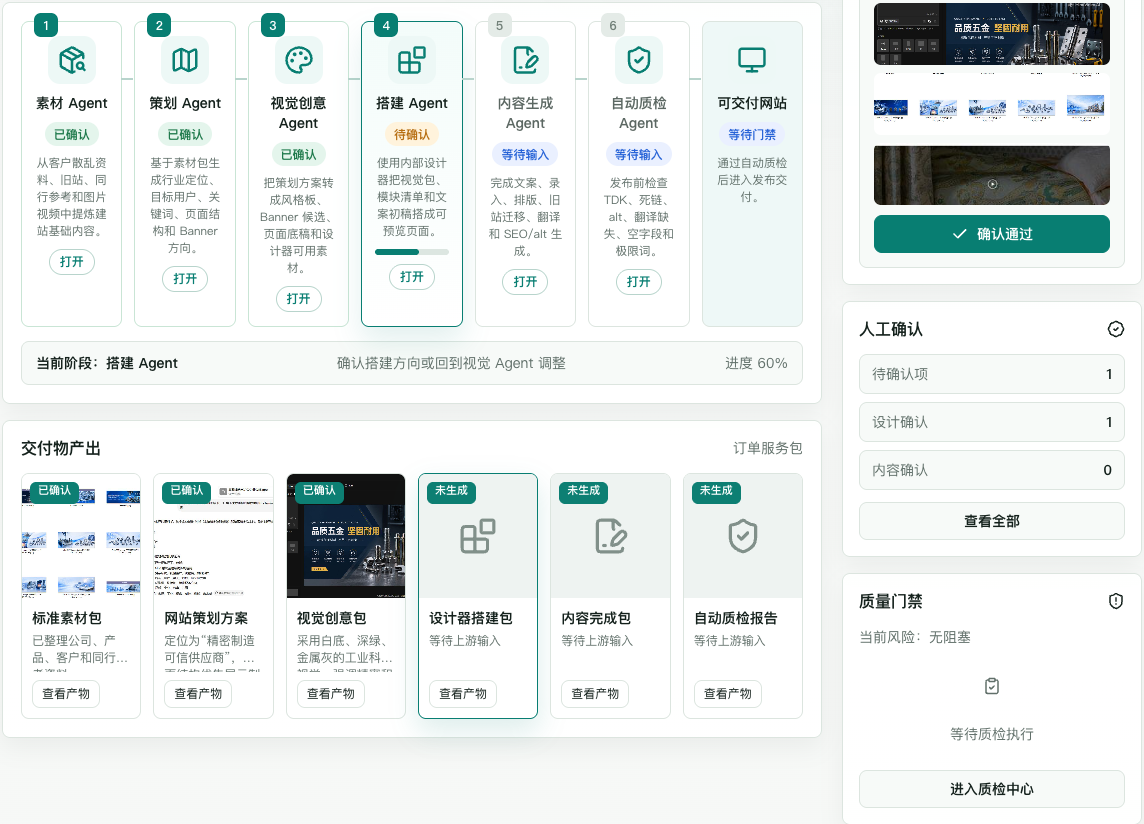
Agent production line confirmation interface
The production line's confirmation interface — humans own taste and sign-off; agents own matching and assembly.
The design
  • People own planning, taste and confirmation; agents own component matching and build
  • Component library structured so models can choose, not just render
  • Hard human gates at the two points where taste decides quality
Why it matters to OpenAI
  • This is "building scalable operating systems" in 2026 grammar
  • Live at ~480 sites/month — production, not a pilot
  • Same pattern now spreading through the unit's other workflows
CASE 05 · SHIPPED PRODUCTS
2026

Products I shipped solo, with AI as the crew

Beyond company walls I build and launch AI products end to end — problem definition, UX, model routing, packaging. It keeps my operator instincts honest about what AI can and cannot do yet.

100x.pics — brand DNA → ad creative

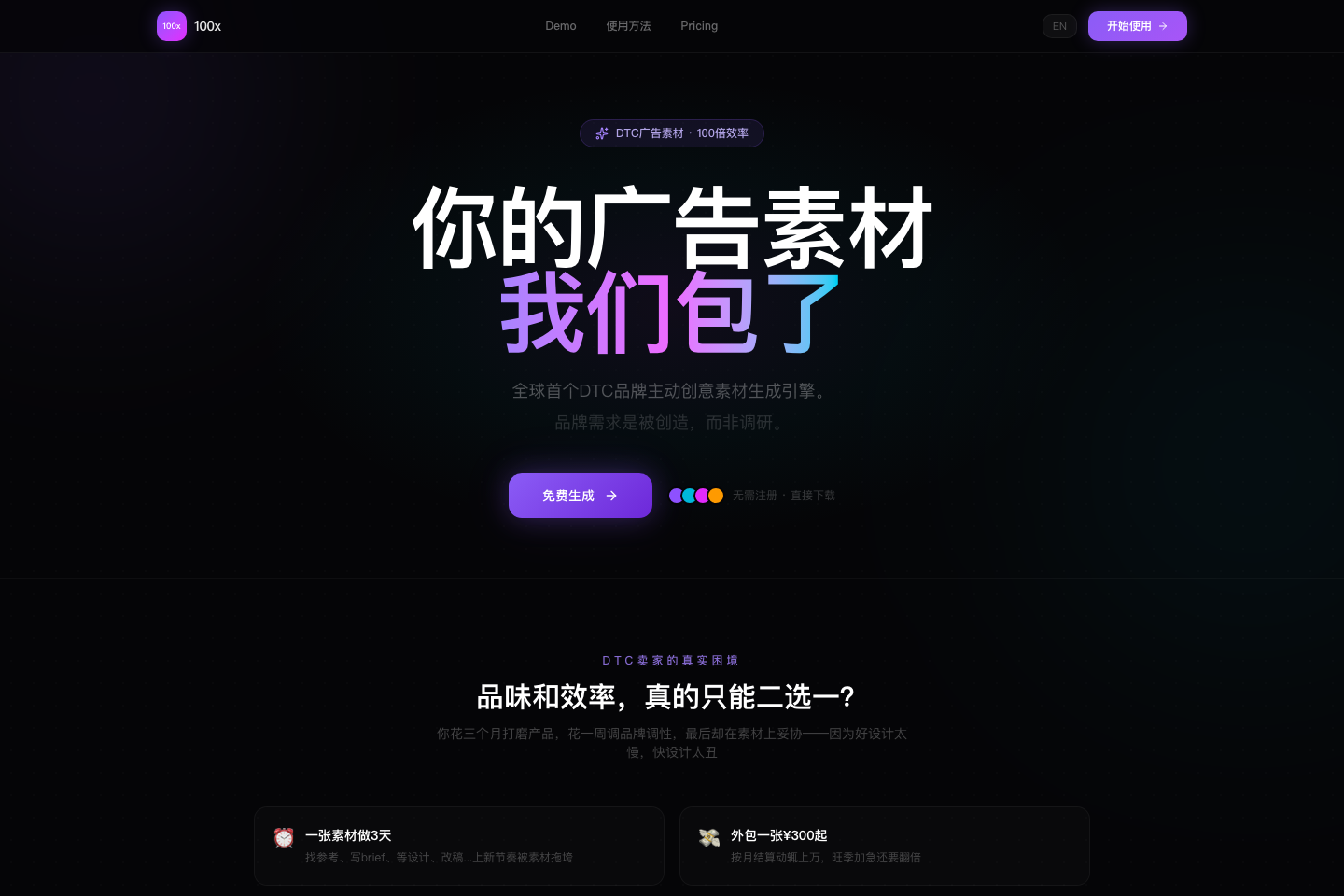
Parses a brand's style and selling points, recommends scenes and platforms, generates and evaluates multi-size ad sets. "Understand → generate → recommend" as the product spine; free trial → free tier → Pro packaging designed from day one.

DTCvideo / dtchub.studio — link → UGC video

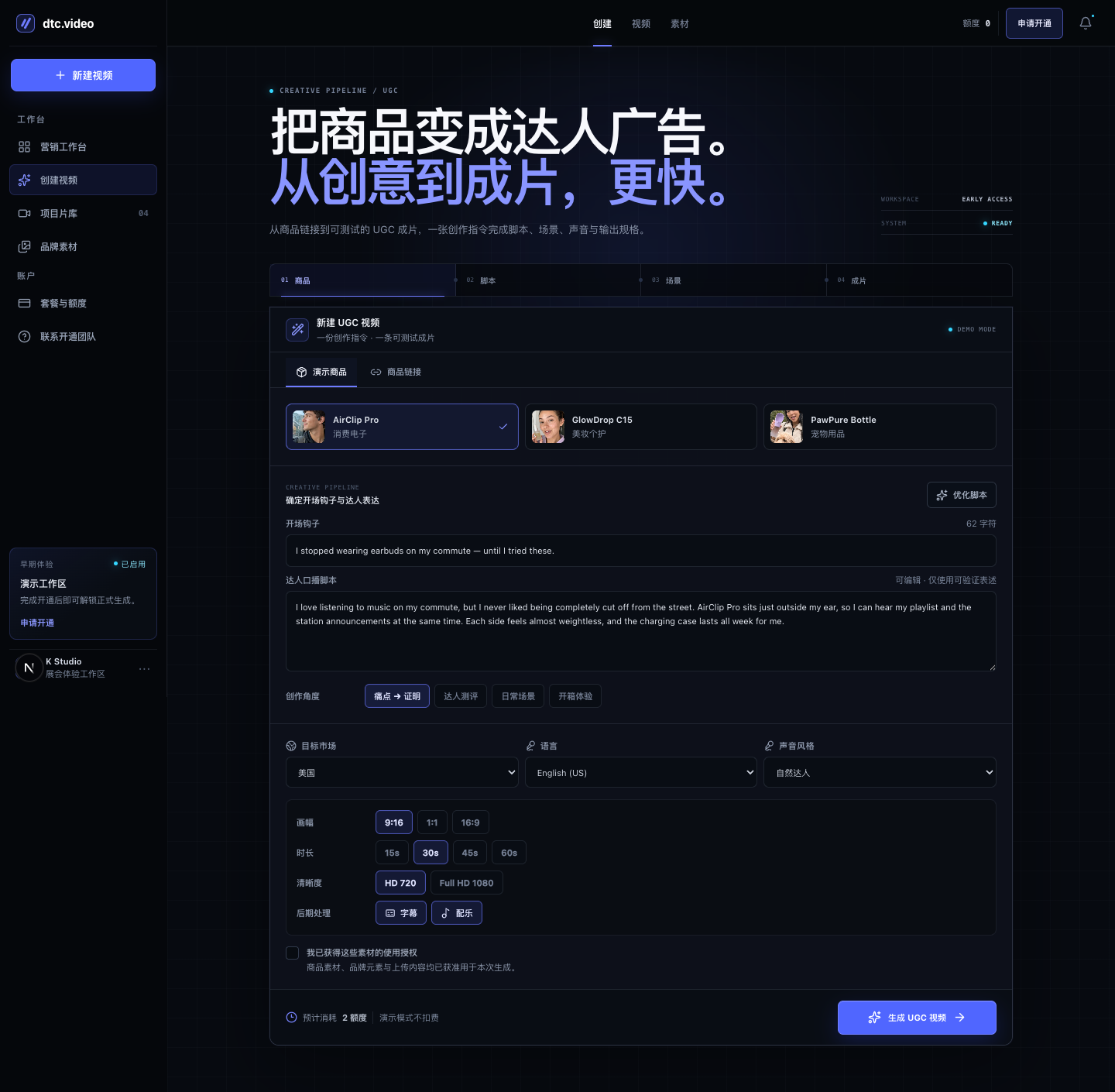
Product link → brand context & assets → market & language → 15–60s UGC videos with unified cast, voice, subtitles, specs. Credit-based packaging for testing vs. scale production.

Why these two
  • Both are operator's tools for cross-border brands — my clients' world
  • Both commercialized, not demos: pricing, packaging, delivery designed
  • Built with ChatGPT, Codex, Claude and Manus — daily fluency, not literacy
100x.pics interface
100X.PICS · brand-DNA ad creative — understand / generate / recommend
DTCvideo interface
DTCVIDEO · product link → UGC video across markets & languages
CASE 06 · FRONTIER FLUENCY
2026

Four hackathons, four finishes — including Singapore

In 2026 I entered hackathons on purpose: the fastest way to keep an operator's judgment calibrated with the frontier. Three of the four finishes are products still in my daily rotation.

4
Hackathons entered in 2026 — four finishes
UCWS · 🇸🇬
Global Hackathon, Singapore — Skill Track 2nd (DoneGraph)
AWS
AWS China Summit hackathon — Champion (Muse)
The record
  • AWS China Summit — Champion. Muse: inspiration capture & creation engine for knowledge workers.
  • UCWS Global Hackathon, Singapore — Skill Track 2nd. DoneGraph: the growth log of AI-assisted work; progress, decisions, evidence, continuity.
  • Ultra Maker — 2nd + Most Commercial Value. With: personal memory & self-insight; built end-to-end with Manus, roadshow deck included.
  • BotLearn SkillHunt — Top 1. MiniLaunch: product-launch agent skill for indie builders.
What the judges couldn't see
  • Each entry is the same operator's question: how should humans and agents divide the work?
  • With was built with Manus before I applied to work near it — I test what I bet on
  • Singapore is already my track record's stage, not a plan
Why this matters for an S&O roleRegional operations at OpenAI means making judgment calls about technology that changes monthly. Calibration requires contact — shipping, breaking, rebuilding. This record is my proof of contact.
CASE 07 · PERSONAL OPERATING SYSTEM
2026

KevinVault: an operating system for one person's context

The same obsession at n=1: I run my own work the way I run a business unit — archives, filters, signal layers, and a contract for how AI may use them.

The system
  • Local Obsidian structure: raw archive → topic cognition → personal judgment → context packs
  • Every claim traceable to a source; human-edit zone and machine zone strictly separated
  • AI agents pull packs before acting — less re-briefing, fewer hallucinated assumptions
Why an S&O team should care
  • It is a working prototype of "context as infrastructure" — the hardest part of agent deployment
  • Same pattern at org scale: decision memory, escalation rules, machine/human boundaries
  • Written up and shared with the community; runs daily on my own machine
Operating principleTeams don't fail from lack of intelligence; they fail from lack of available context. Build the memory layer first, and every agent — or every new hire — ramps in days, not months.
CLOSING

What I'd bring to SEA & ANZ

A three-part offer — the operator's craft this role names, an AI-native edge nobody else in the stack brings, and full commitment to the region.

01
The operating craft
  • 0→1 unit build with P&L accountability: ¥240M in three quarters
  • Operating systems that survived scale: SOPs, KPI frameworks, cadences, renewal loops
  • Multi-market expansion method proven on five ad channels and two regions' award juries
02
The AI-native edge
  • Agent production lines in daily delivery — 50%+ efficiency, 480 sites/month
  • Shipped AI products and four hackathon finishes, Singapore included
  • Context engineering in practice (KevinVault) — transferable to org-scale operations
03
The commitment
  • Ready to relocate to Singapore; committed to SEA & ANZ for the long run
  • First-year focus: one operating cadence & KPI spine across the region
  • Delivery-ready playbooks before every expansion step; agent leverage over headcount addiction
Why OpenAIOpenAI is scaling a regional operating model across APAC. That is precisely the work I've done for the last three years — minus the frontier. I bring the operating discipline, the multi-market expansion record, and an operator's fluency in AI that comes from shipping agent systems in production, not from reading about them.